992 Collection
991 Collection
718 Collection
Wheels
Accessories


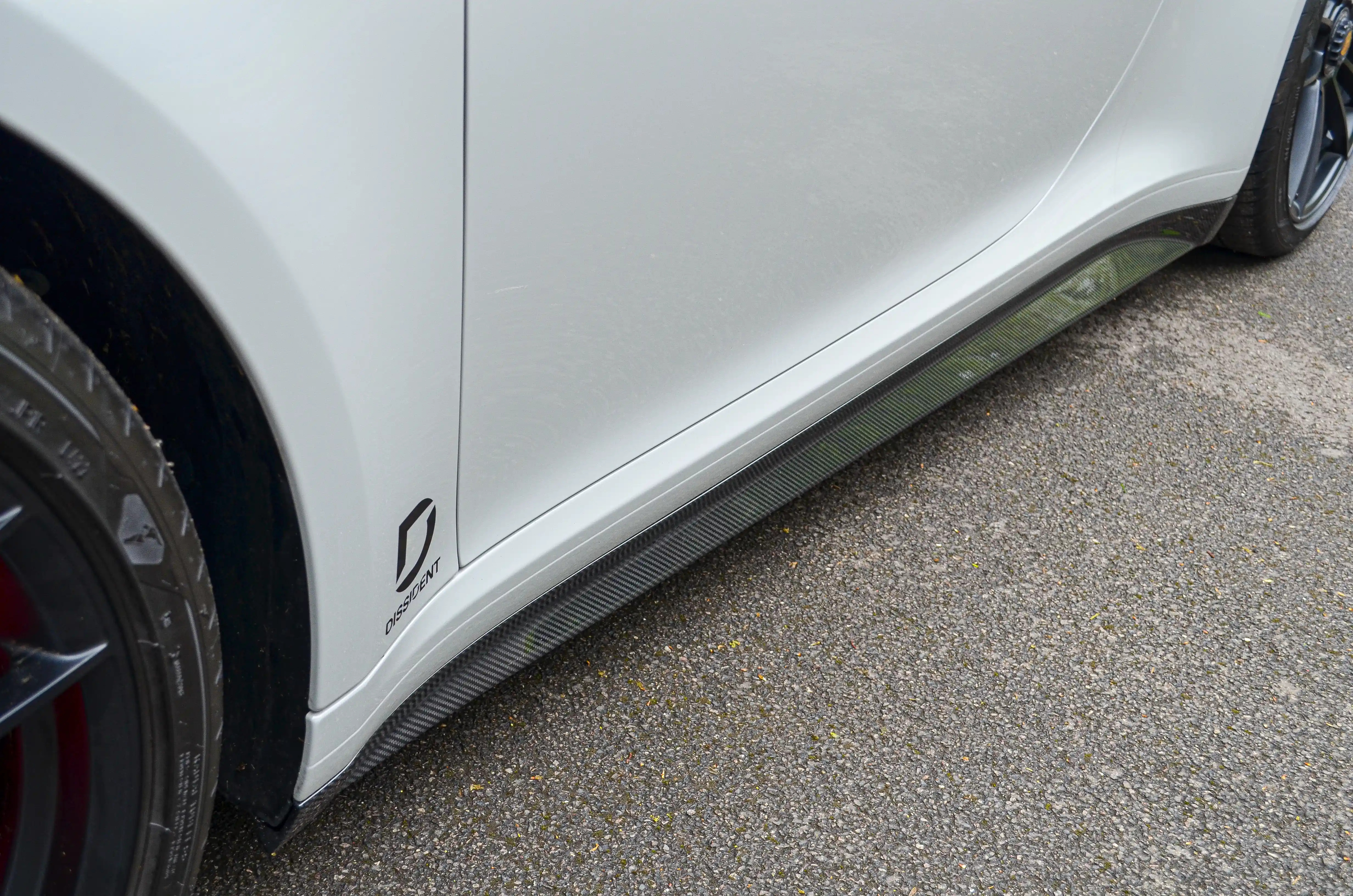
The parts that change a 911 most are not the ones people photograph. Side skirts, door triangles and fuse cover panels all replace factory plastic with carbon, and the cheapest of them costs less than a set of tyres. Here is what each one does to the car, what it costs, and why the small parts work harder than the big ones.
Every 911 leaves the factory with plastic in places you look at every day. The panel behind each mirror. The rocker panel running the length of the car. The cover on the fuse panel in each footwell.
None of it is bad plastic. It is just plastic, sitting a few inches from carbon Porsche did fit, and that contrast is the reason these parts sell.
This is the honest guide to the detail range. Three families of part, prices from £300, and a view on which order to do them in.
Three, in descending order of effect and ascending order of value. Side skirts at £2,390 to £2,850 change the car's stance from ten paces. Door triangles at £300 to £475 a pair change the mirror area, which is where the eye already goes. Fuse cover panels at £395 to £495 change the cabin.
Per pound spent, the triangles win by a distance. They are the cheapest external carbon part in the range and they sit in the most visible spot on the flank of the car.
Per unit of visual change, the side skirts win. They run the length of the car and they drop the visual centre of gravity.
Most owners end up doing all three, and the order they do them in usually follows the budget rather than the logic.
Side skirts, sometimes called rocker panels, run along the bottom edge of the car between the wheel arches. Porsche fits them in textured plastic. Replacing them with carbon does two things: it lowers the visual line of the car and it puts a continuous carbon element down the flank rather than a few isolated pieces.
The 992 side skirts mount on the original points. Fitment takes minutes, nothing is cut, drilled or bonded, and the whole thing is reversible. They are made for all 992.1 and 992.2 Carrera models plus GT3 and GT3 Touring.
Ground clearance drops by 20mm. That is the number to hold against your driveway, your trailer ramp and the car park you use most often. It is not a small change and it is the one thing to check before ordering.
Prices run £2,450 to £2,850 for 992.1 and £2,390 to £2,790 for 992.2 depending on finish.
The door triangle is the panel behind each door mirror. Two versions exist. The standard triangle is flat and reads as the quieter of the two at £300 to £400 a pair. The anti-buffet version adds an aero lip that reduces cabin booming with a window down, at £375 to £475.
The standard door triangles are made for 992 Turbo, GT3 and Carrera models, and there are 991 and 718 versions of the same part.
The anti-buffet triangles are the ones to have if the car gets driven with the windows down or the roof stowed. The aero lip is not cosmetic. It changes the airflow at the leading edge of the window opening, and the difference in cabin noise is audible.
Both replace the factory plastic on the factory points and both come off again in minutes.
One in each footwell, supplied as a pair, replacing the plastic cover the factory fits. At £395 to £495 they are the cheapest way to bring carbon into a cabin that already has some.
The one thing to check is weave. The fuse cover panels come in a 1x1 plain weave for Carrera and GTS cars, which is what those cars most commonly carry inside, and a GT3 version matched to what GT3 cabins carry.
Order the wrong one and you get carbon that fights the carbon already there, which is worse than plastic.
They are also the part owners notice most often, because a footwell is at eye level every time you get in.
Proximity. That is the whole argument.
Porsche puts high-gloss carbon on mirror shells, mirror triangles, roof panels and airblades depending on model and options. Every one of those sits within a few inches of a plastic panel that could be carbon. The eye reads the join, not the individual part.
Which is why a £300 pair of triangles can do more for how a car reads than a £2,000 part somewhere isolated. You are not adding carbon. You are removing the interruption.
The same logic explains why doing parts together beats doing them one at a time. Cloth runs vary between batches, and parts made in the same run sit better next to each other than parts bought a year apart. If the plan is two or three things, order them together.
It also saves on fitting. Most independent specialists charge by the visit rather than the part, and everything here goes on with the car in the same place.
Everything is autoclave-cured pre-preg carbon, hand-built in the UK, in a 2x2 twill matched to the weave Porsche uses on its own mirrors and roof panels, apart from the fuse covers, which use the 1x1 plain weave found inside the cars. Pre-preg means the cloth arrives with the resin already measured into it. An autoclave cures the part under heat and pressure together, which keeps a long thin part like a side skirt straight across its whole length.
That matters more on skirts than anywhere else. A skirt is over a metre long and any twist in it shows as a widening gap along the sill.
Finishes run from gloss lacquered visual carbon through bare carbon to gloss black and primer. Skirts live in the spray off the front tyres, so gloss black and primer are the sensible choices on a car used through winter.
Every part is delivered with a written fitting guide, and there is a technical team on the contact form for fitting questions. Parts in stock go out quickly, and parts built to order are dispatched within 14 to 35 days.
Three things to take away. Check the 20mm ground clearance drop before ordering skirts. Choose the anti-buffet triangles if the car gets driven with the windows down, because the aero lip does a real job. And match the fuse cover weave to what is already in your cabin.
Start with the 992 door triangles.
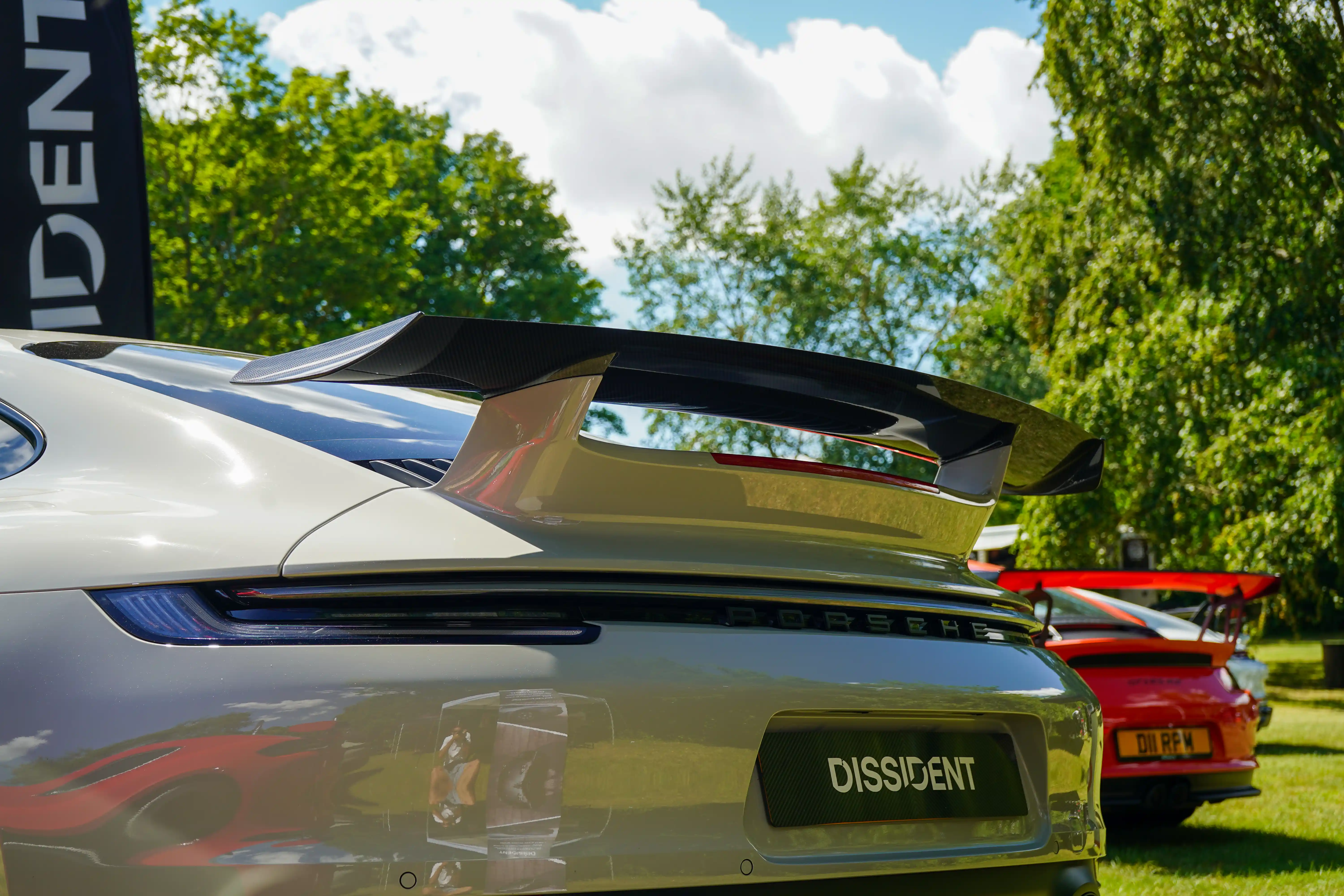
A GT wing works the air above the car, a ducktail changes where it leaves. What each does, what fits, and which suits your Porsche.
Read article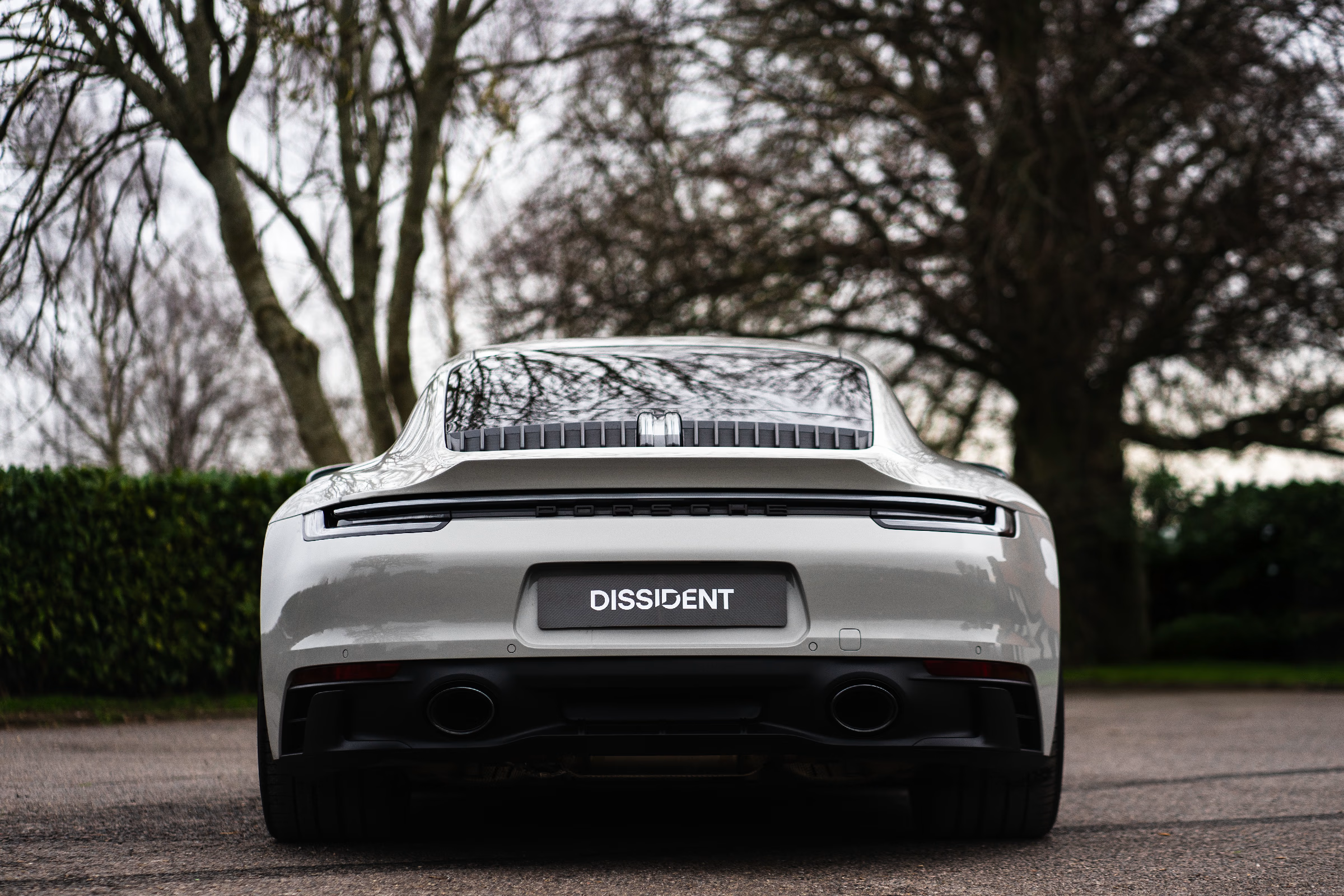
The ducktail spoiler started as a fix for 911 lift in 1972. Where it came from, what it changed, and why it still suits a modern 911.
Read articleSide skirts run £2,390 to £2,850 depending on generation and finish, door triangles are £300 to £400 a pair for the standard version and £375 to £475 for the anti-buffet, and fuse cover panels are £395 to £495 for the pair. All replace factory plastic on the original mounting points.
The standard triangle is flat and reads as the quieter of the two. The anti-buffet version adds an aero lip that reduces cabin booming noise when driving with a window down or the roof stowed. If the car gets driven open, the anti-buffet version is worth the extra, because the lip does a real job rather than a cosmetic one.
Ground clearance drops by 20mm. That is the number to check against your driveway, your trailer ramp and the car park you use most. Fitment itself takes minutes on the original mounting points, with no cutting, drilling or bonding, and it is fully reversible.
Match the weave to what is already inside the car. The Carrera and GTS version uses a 1x1 plain weave, which is what those cabins most commonly carry, and there is a separate GT3 version. Ordering the wrong one gives you carbon that fights the carbon already there.
Order them together. Cloth runs vary between batches, so parts made in the same run sit better next to each other than parts bought a year apart. It also saves on fitting, because most independent specialists charge by the visit rather than by the part and everything here goes on with the car in one place.