

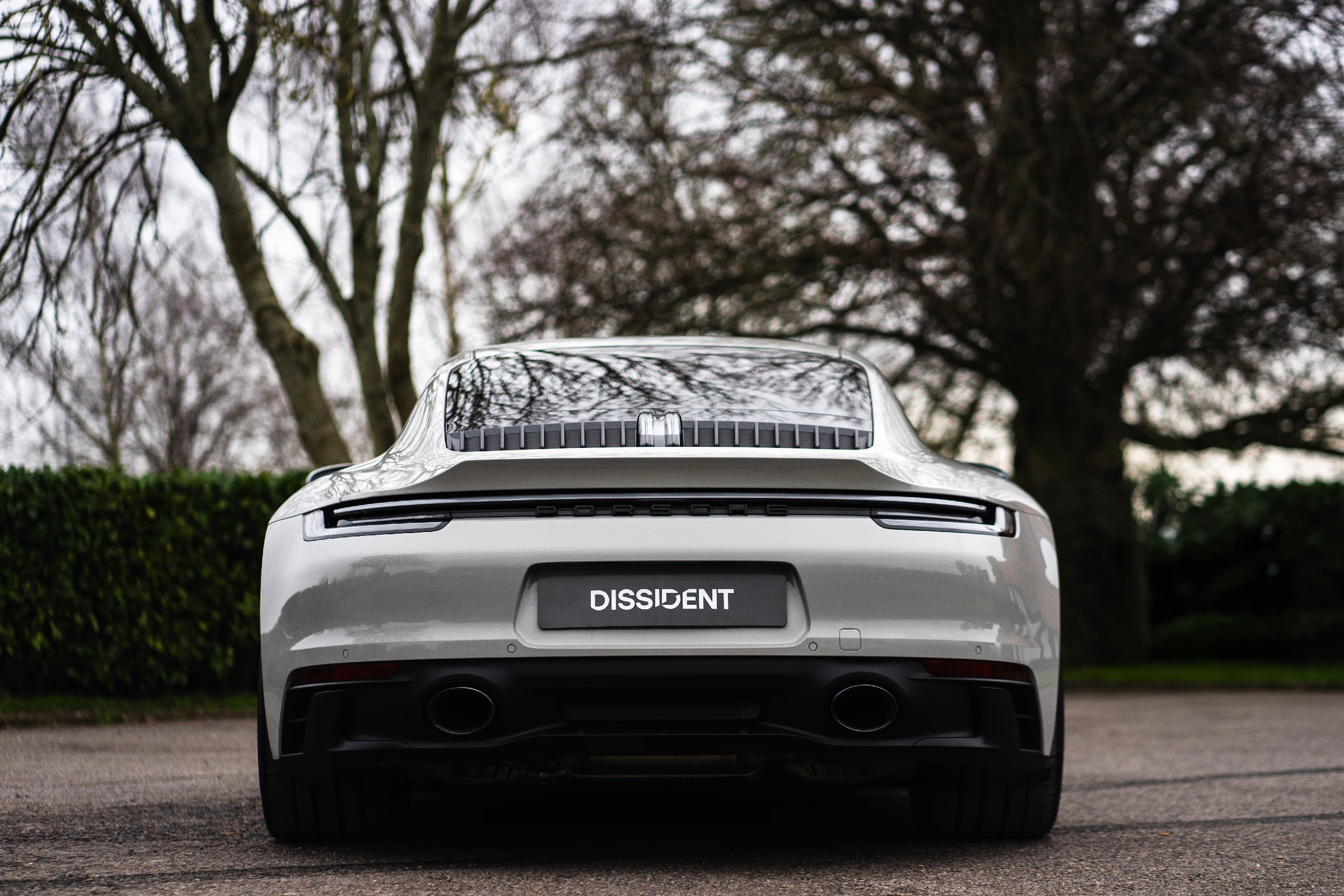
The ducktail was not a styling exercise. It was a fix for a handling problem, drawn by a 26-year-old aerodynamicist who was told he could not change the shape of the 911. It became the most recognisable rear end in motoring by accident, and the reason it still works on a modern car is that the problem it solved never went away.
Fifty-odd years on, the shape is everywhere. It sits on 964s and 993s that never came with one, on Sport Classics as a factory tribute, and on 991s and 992s as an aftermarket part.
Most of what gets written about it starts and stops at "iconic". The story underneath is better than that, and it explains why the shape has survived four decades of aerodynamic progress without being improved on.
A ducktail is a rear deck lid extension that curves upward at its trailing edge, ending in a sharp lip. It manages where airflow separates off the back of the car. Because the lip sits at the trailing edge rather than standing above the body on struts, it reduces rear lift without the drag penalty a wing brings.
The distinction matters. A wing works on the air passing over and under it. A ducktail works on the point at which air lets go of the bodywork, which is a cheaper way to buy the same stability.
On a 911 it also solves a problem specific to the car. The 911's roofline slopes down into the engine cover, and that shape behaves like an aerofoil at speed.
In 1972 Helmuth Bott, Porsche's head of development, asked the aerodynamicist Hermann Burst to work out why the 911 was generating so much lift at speed. Burst brought in Tilman Brodbeck, then 26 and fresh from an aeronautics degree at Darmstadt, and the stylist Rolf Wiener.
The brief had a hard constraint. They were not allowed to change the original shape of the 911, so they had to find the simplest way to improve both drag and lift within it.
Brodbeck went to the wind tunnel with sheet metal and wooden blocks. Three variants over three days produced the shape. Test driver Günter Steckkönig then drove a development car with and without it at Weissach, and it was quicker with.
Porsche lodged the patent on 5 August 1972. Document 2238704 describes a passenger car with a rear spoiler, preferably mounted between side panels, and an aerodynamic device in the rear to increase dynamic rear wheel pressure. The car it went on, the 911 Carrera RS 2.7, was shown at the Paris Motor Show that October.
Colleagues at the test track laughed at it. Brodbeck has said it took him a long time to realise they had created an icon.
Three things, and only one of them was the intention. It cut rear lift substantially, it improved cooling by feeding air to the engine behind the rear axle, and it raised top speed rather than lowering it.
That last part is the one that surprises people. Porsche's own account records the effect coming without any increase in drag, with top speed rising by 2.8 mph. A taller spoiler reduced drag, because cleaning up the separation behind the car did more good than the extra frontal area did harm.
The Carrera RS 2.7 became the first series production car with front and rear spoilers, and the fastest German production car of its day.
Even the height was decided by something outside aerodynamics. The spoiler was capped because German regulators were concerned about motorcyclists striking the sharp trailing edge.
Porsche did not call it that. Internally the part was the Bürzel, which translates roughly as rump. The German press turned it into Entenbürzel, a duck's rump, and the English-speaking world shortened it to ducktail.
The name stuck because it is accurate. Seen in profile the shape does exactly what the tail feathers of a duck do, which is flick upward at the last moment.
Porsche needed 500 cars for FIA Group 4 homologation. They sold out in three months and 1,580 were built in the end.
Because the car still has the same rear.
A 992 is wider, heavier and vastly more sophisticated than a 1973 RS, but the roofline still runs down into an engine cover and the engine is still behind the rear axle. Porsche's own answer on a modern Carrera is a deployment spoiler that rises out of the deck at speed and drops again in a car park.
That deployment panel is the direct descendant of the ducktail, and it is the part every ducktail we make replaces. Which is a neater loop than it sounds: fifty years of engineering have produced a motorised version of a shape that worked when it was fixed.
There is a second reason, and it is about proportion rather than physics. The 911's rear three quarter is the angle the car is photographed from and the angle you see it from as you walk away. The ducktail is the only rear aero shape that adds presence there without adding height.
A wing changes the silhouette. A ducktail completes it.
Two versions, and the difference is what happens to the mechanism underneath.
The 992.1 mini ducktail coupe at £1,625 to £2,500 replaces the plastic cover over the deployment spoiler and leaves the motor and mechanism in place. It still rises and drops exactly as before, no electrical work is needed, and it comes off in minutes. The 991.2 ducktail does the same job on the earlier car from £1,195.
The 992.1 fixed ducktail at £3,350 to £4,300 takes the other route, removing the deployment unit entirely and coding it out. It is the closer interpretation of the 1973 shape, and the bigger commitment.
Both are autoclave-cured pre-preg carbon, hand-built in the UK, in a 2x2 twill matched to the weave Porsche uses on its own mirrors and roof panels. Finishes run from gloss lacquered visual carbon through bare carbon to body colour, with or without a carbon accent.
Parts in stock go out quickly, and parts built to order are dispatched within 14 to 35 days.
The thing worth holding on to is that none of this is nostalgia. The ducktail is on modern 911s because the aerodynamic problem Brodbeck was handed in 1972 is still there in 2026, and the answer he found in three days in a wind tunnel has not been bettered for a road car.
Start with the 992.1 mini ducktail.
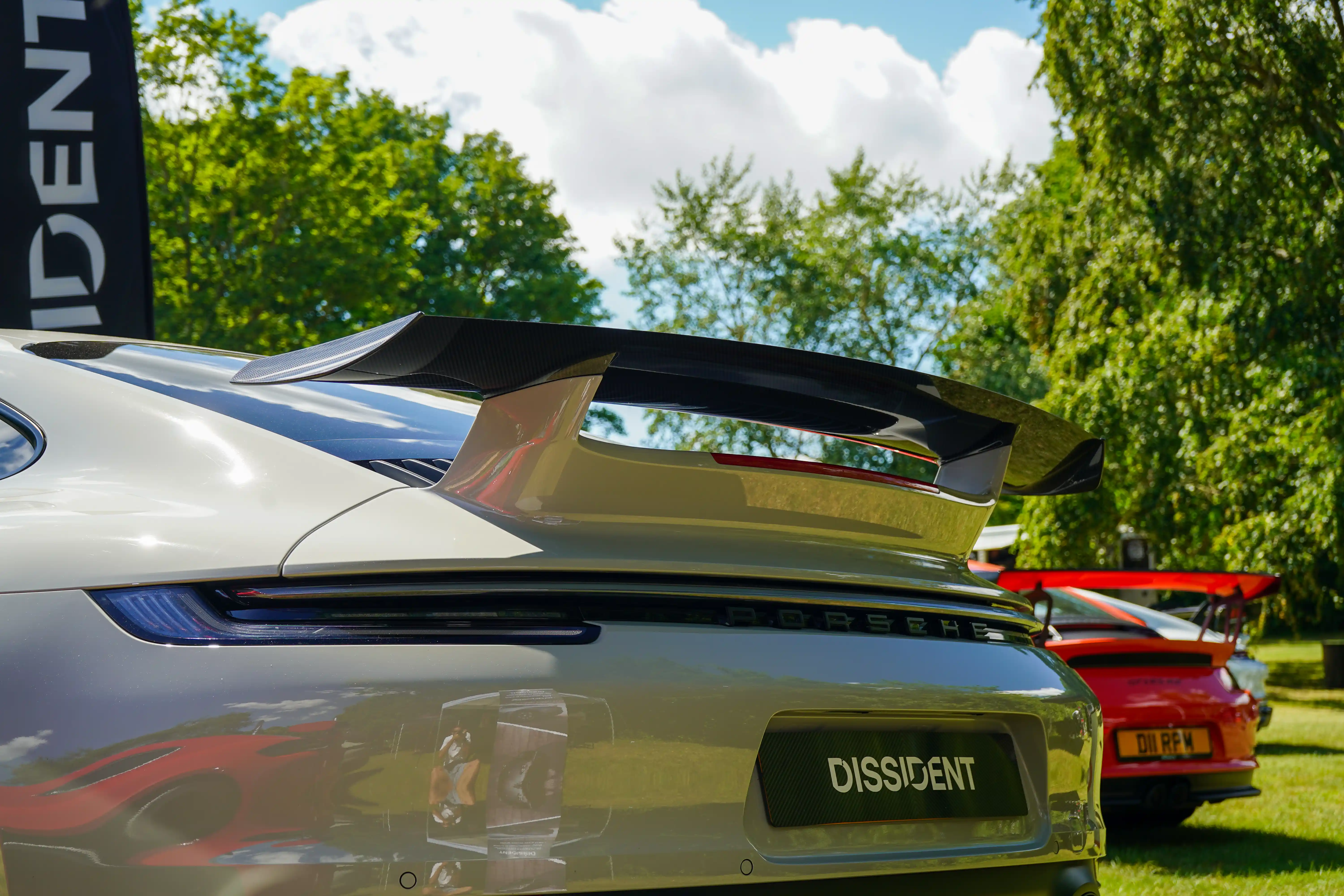
A GT wing works the air above the car, a ducktail changes where it leaves. What each does, what fits, and which suits your Porsche.
Read article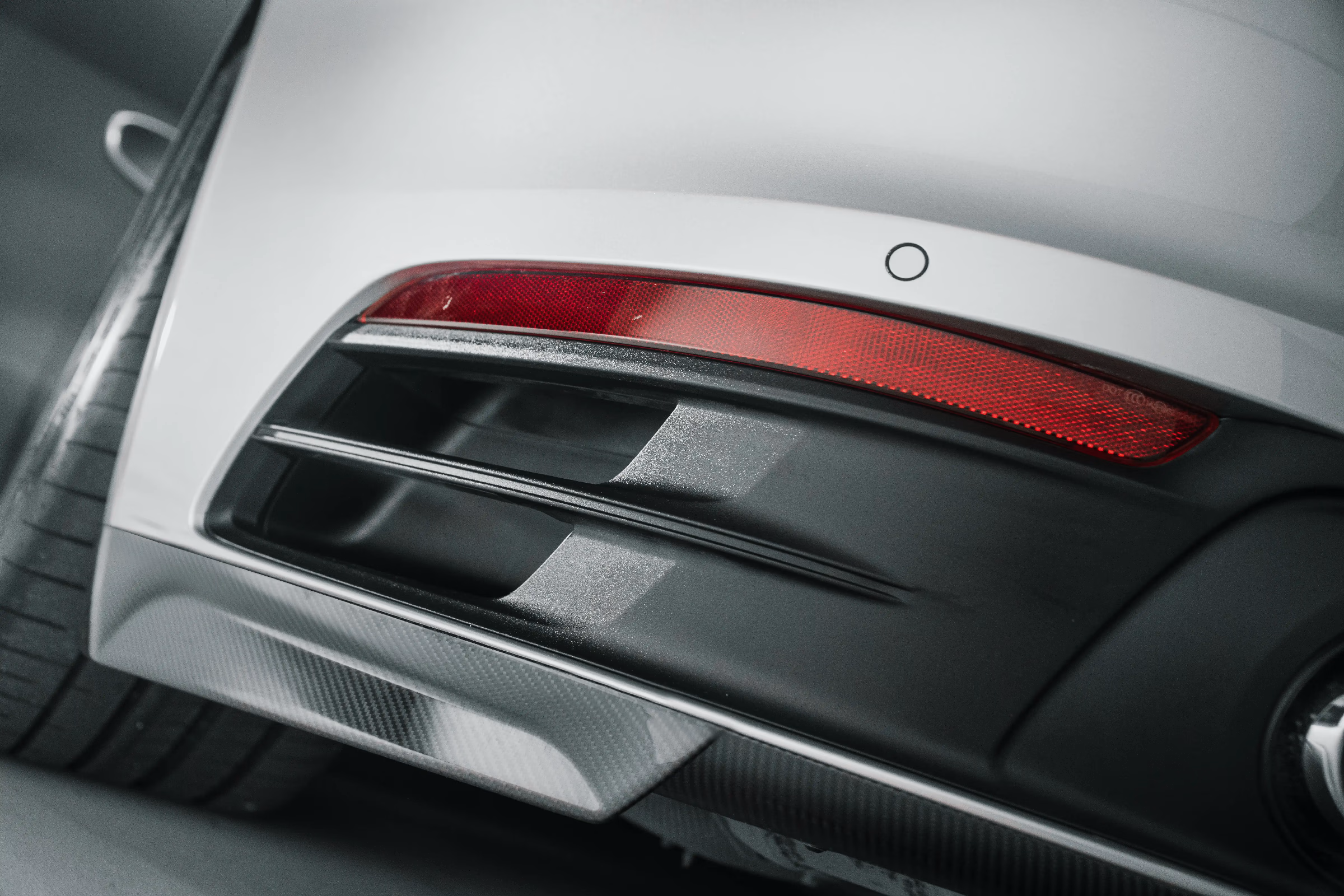
How a rear diffuser works, why most aftermarket ones do little, what to check before buying, and which one fits your Porsche bumper.
Read articleA ducktail is a rear deck lid extension that curves upward at its trailing edge and ends in a sharp lip. It manages where airflow separates off the back of the car, which reduces rear lift without the drag penalty a wing brings. It works on the point at which air lets go of the bodywork rather than on air passing over and under a blade.
The 1973 Porsche 911 Carrera RS 2.7. Porsche lodged the patent on 5 August 1972 and the car was shown at the Paris Motor Show that October. It was the first series production model fitted with front and rear spoilers, and the fastest German production car of its day.
Porsche called the part the Bürzel internally, which translates roughly as rump. The German press turned it into Entenbürzel, meaning a duck's rump, and the English speaking world shortened that to ducktail. The name stuck because the profile does what a duck's tail feathers do, which is flick upward at the last moment.
It cut rear lift substantially, improved cooling by feeding air to the engine behind the rear axle, and raised top speed rather than lowering it. Porsche's own account records the effect coming with no increase in drag and top speed rising by 2.8 mph, because cleaning up the separation behind the car did more good than the extra frontal area did harm.
Yes. On a modern Carrera the ducktail replaces the plastic cover over the deployment spoiler. The mini ducktail leaves the motor and mechanism in place, so the panel still rises and drops, and it comes off in minutes. The fixed ducktail removes the deployment unit entirely and needs coding as part of fitment.