

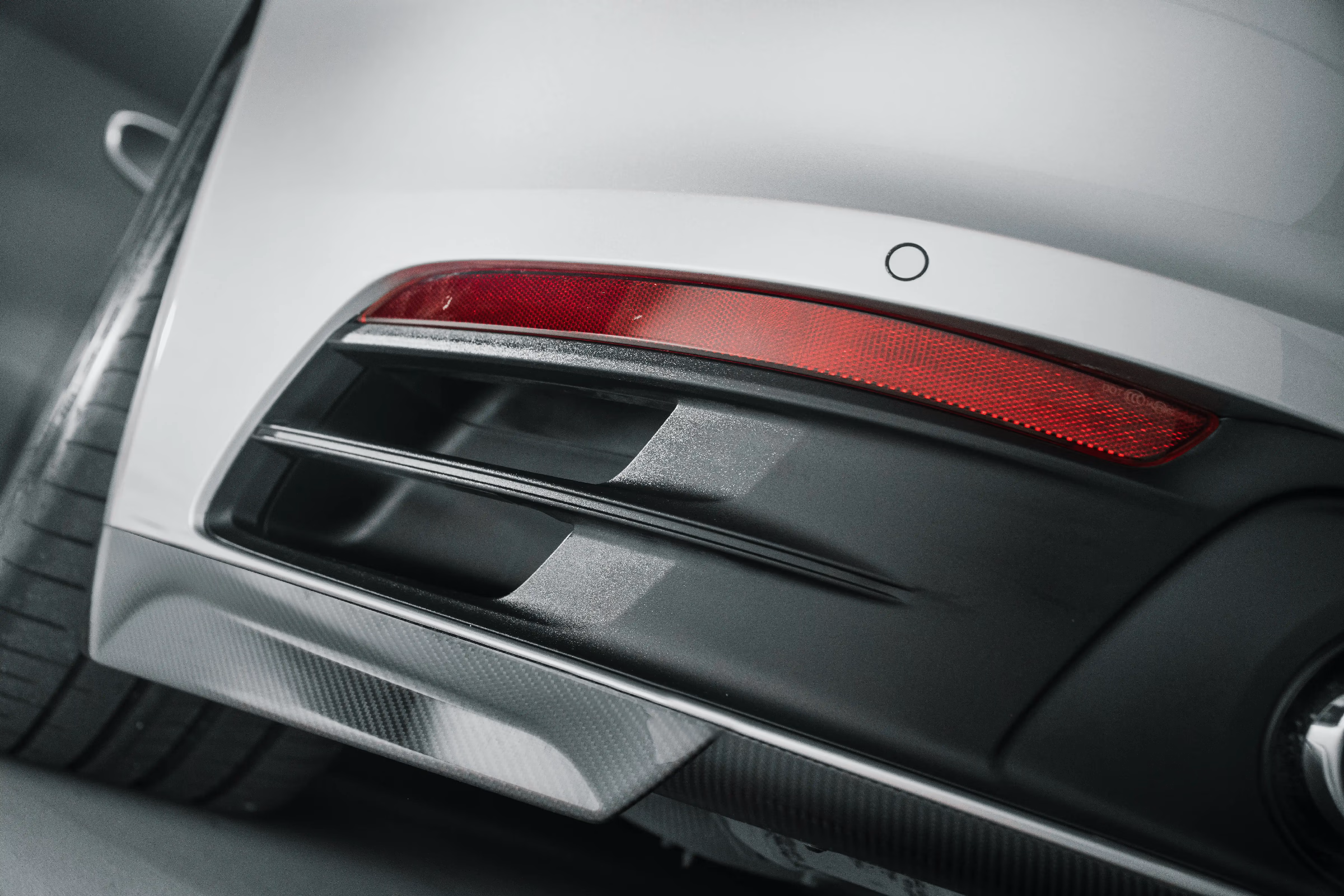
A rear diffuser is the shaped section of underbody at the back of a car, and on a properly developed one it is the most efficient downforce device on the vehicle. On most road cars, and on most aftermarket parts, it does far less than that. Here is how a diffuser works, why so few of them work properly, and which one fits your car.
Search for a rear diffuser and you will find parts from £80 to £2,000, all doing the same job on paper. They are not doing the same job.
The gap comes down to one thing. A diffuser is the end of a system, not a component you bolt on. Without the rest of the system in place it is a piece of trim with fins on it, and there is nothing wrong with that as long as you know it going in.
So this is the version from a workshop that makes them. The physics, the honest limits on a road car, and what to check on a listing before you spend anything.
A diffuser is an upswept section of the rear underbody that gives the fast-moving air under the car somewhere to slow down and expand. That expansion eases high-velocity underbody air back to normal speed and fills the wake behind the car, which cuts drag and pulls the whole underbody into producing downforce.
The mechanism runs backwards from what most people assume. The diffuser does not push the car down. It lowers the pressure under the car by accelerating the air ahead of it, and the outside pressure does the pushing.
Because the exit area of a diffuser is larger than its inlet, air has to be travelling faster at the inlet. Faster air means lower pressure, and lower pressure under the car than above it is what downforce is.
It is also the efficient way to do it. A diffuser creates an expansion chamber for air without generating the large drag penalty a wing does, which is why racing regulations spend so much effort restricting them.
Here is the part the listings leave out. A working diffuser needs three things: a smooth underbody feeding it, an expansion chamber with the right angle, and vertical fins to keep the flow in order. Most aftermarket diffusers have one of the three, the fins.
The smooth underbody is the one nobody sells you. If the air arriving at the back of the car has already been churned up by exhaust hangers, suspension arms and a partly panelled floor, there is nothing clean for the diffuser to work with.
Angle is the second problem. Too shallow and the expansion does very little. Too steep and the flow separates from the surface, stalls, and you get drag instead of downforce. That angle depends on ride height and rake, which is why a diffuser designed for one car does not transfer to another.
None of that makes a road diffuser pointless. It just moves the benefit somewhere more modest, which we will come to.
The strakes are the vertical fins running fore and aft through the diffuser. They divide it into channels, stop pressure equalising across its width, and shed vortices that act as virtual walls along each channel edge. Those vortices seal the low-pressure area against high-pressure air rushing in from the sides.
Worth being precise about what that means. Strakes protect diffuser performance rather than create it. On a road car they help keep the effect consistent rather than raise the peak.
Which is why fin count is a poor way to judge a diffuser. More fins on a part that has no sealed floor behind it is more decoration, not more downforce.
What fins do reliably deliver is visual depth. Light falls into the channels and the part reads as machined rather than moulded, and on a car where the rear valance is otherwise a slab of plastic, that is a real gain.
Modestly, and mostly in a way you will not feel. Without a flat floor ahead of it, a road diffuser generates limited downforce. What it does do is tidy the turbulent air coming off the back of the car, reducing the parachute effect where air gets trapped in the rear bumper.
That drag reduction is real and it is small. Nobody should buy one expecting a stopwatch to notice.
The honest reasons to fit one are the ones people rarely say out loud. It changes the proportion of the rear of the car, it replaces a large piece of textured plastic with carbon, and it finishes the bottom edge of the bumper the way a factory GT car does.
Judge it on that and it is easy value. Judge it on downforce numbers and you will be disappointed by every diffuser on the market that is not attached to a race car.
It also works with the parts either side of it. Our own 992 diffuser was designed to sit alongside the 992 side sills, which carry the line down the flank and into the rear valance rather than leaving it to stop halfway.
Rear bumper geometry decides it, and on a 991 the exhaust decides it too. There are three parts across the current range and they are not interchangeable.
The 992.1 rear diffuser at £1,495 to £1,850 fits 992.1 Carrera models with the standard base rear bumper. If your car has Sport Design bumpers, this is not the part.
Sport Design and GTS cars take the 992.1 diffuser for GTS and Sport Design at £1,895, which mounts to the rear bumper on the original points and fits every body type, coupe, cabriolet and Targa.
On a 991 the 991.2 rear diffuser at £1,155 to £1,390 fits 991.2 Carrera models with the sports exhaust option, meaning the central exhaust pipes. Cars on the standard twin outboard tailpipes have different valance geometry and need a different part.
Check the back of your car before ordering. Sport Design or base, central pipes or outboard. Those two questions answer almost every fitment query we get.
Five things, in the order they matter.
What it is made from, said plainly. Pre-preg and autoclave should appear on the product page. If the listing says carbon and nothing else, ask what sits behind the visible face.
Whether it is moulded for your bumper or trimmed to fit. A part made for a specific rear valance sits flush along its whole top edge. A universal part is packed out at the ends and it shows from three metres away.
How it mounts. Original mounting points mean no drilling and full reversibility. Anything relying on tape and self-tappers is a decision you cannot easily undo.
The depth of the fins and how the light falls into them. This is the cosmetic point and it is the one you will look at every day.
And ground clearance. A diffuser hangs at the lowest point of the rear of the car, right where a steep driveway exit finds it.
Everything we make is autoclave-cured pre-preg carbon, hand-built in the UK, in a 2x2 twill matched to the weave Porsche uses on its own mirrors and roof panels. Pre-preg means the cloth arrives with the resin already measured into it. An autoclave cures it under heat and pressure together, which is what keeps a wide part like a diffuser dimensionally accurate across its whole span.
That accuracy matters more on a diffuser than almost anywhere else, because the part spans the full width of the car and any twist shows as an uneven gap along the top edge.
Finishes run from gloss lacquered visual carbon through bare carbon to gloss black and primer. Diffusers live in the spray off the rear tyres, so gloss black and primer are the pragmatic choices on a car used through winter.
Every part is delivered with a written fitting guide, and we recommend a professional fitment. Parts in stock go out quickly, and parts built to order are dispatched within 14 to 35 days.
Three things to take away. A diffuser is the end of a system, so on a road car without a flat floor treat it as a styling part that happens to cut a little drag. Fin count is not a measure of anything. And rear bumper type, plus exhaust layout on a 991, decides what you can buy.
Start with the 992.1 rear diffuser.
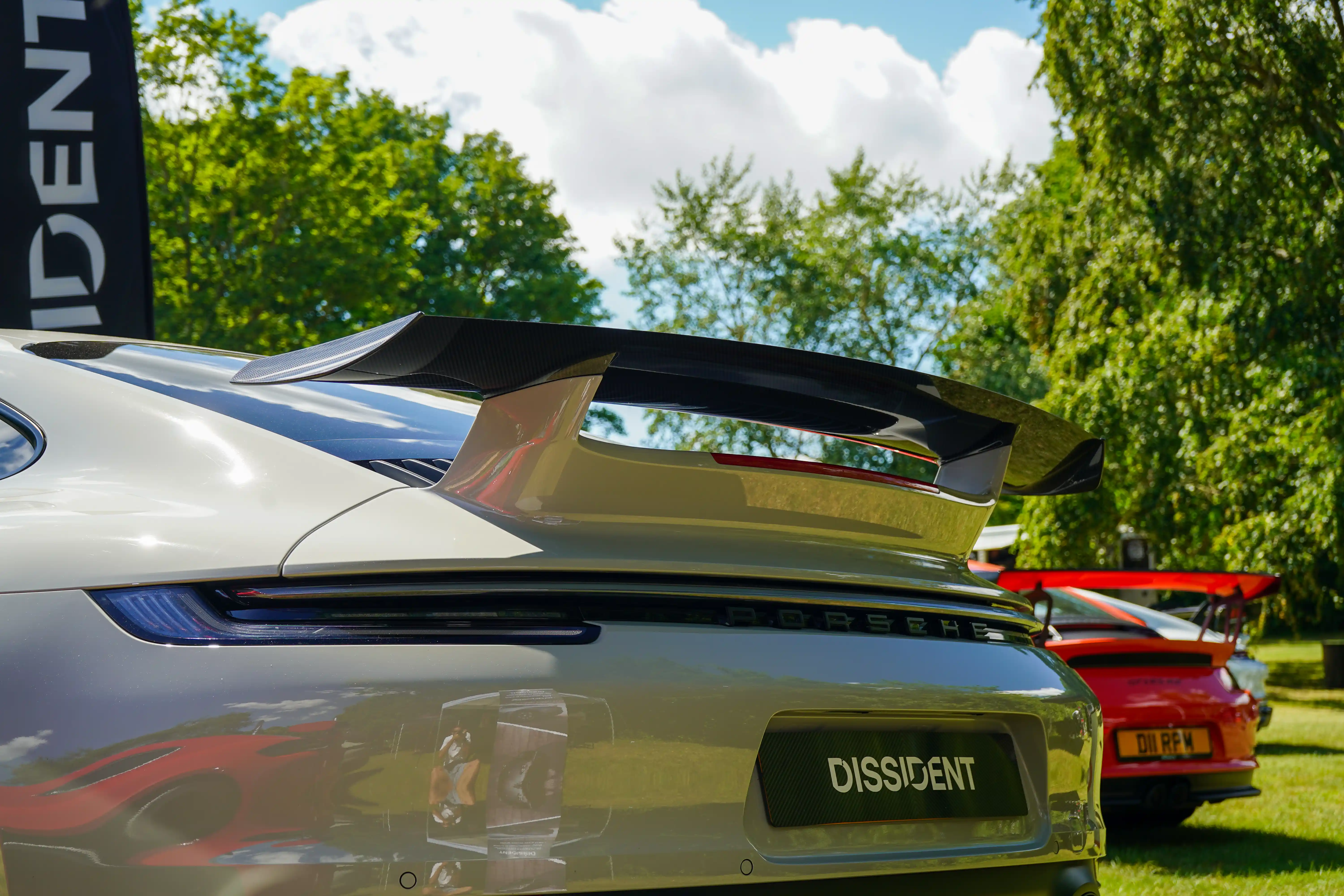
A GT wing works the air above the car, a ducktail changes where it leaves. What each does, what fits, and which suits your Porsche.
Read article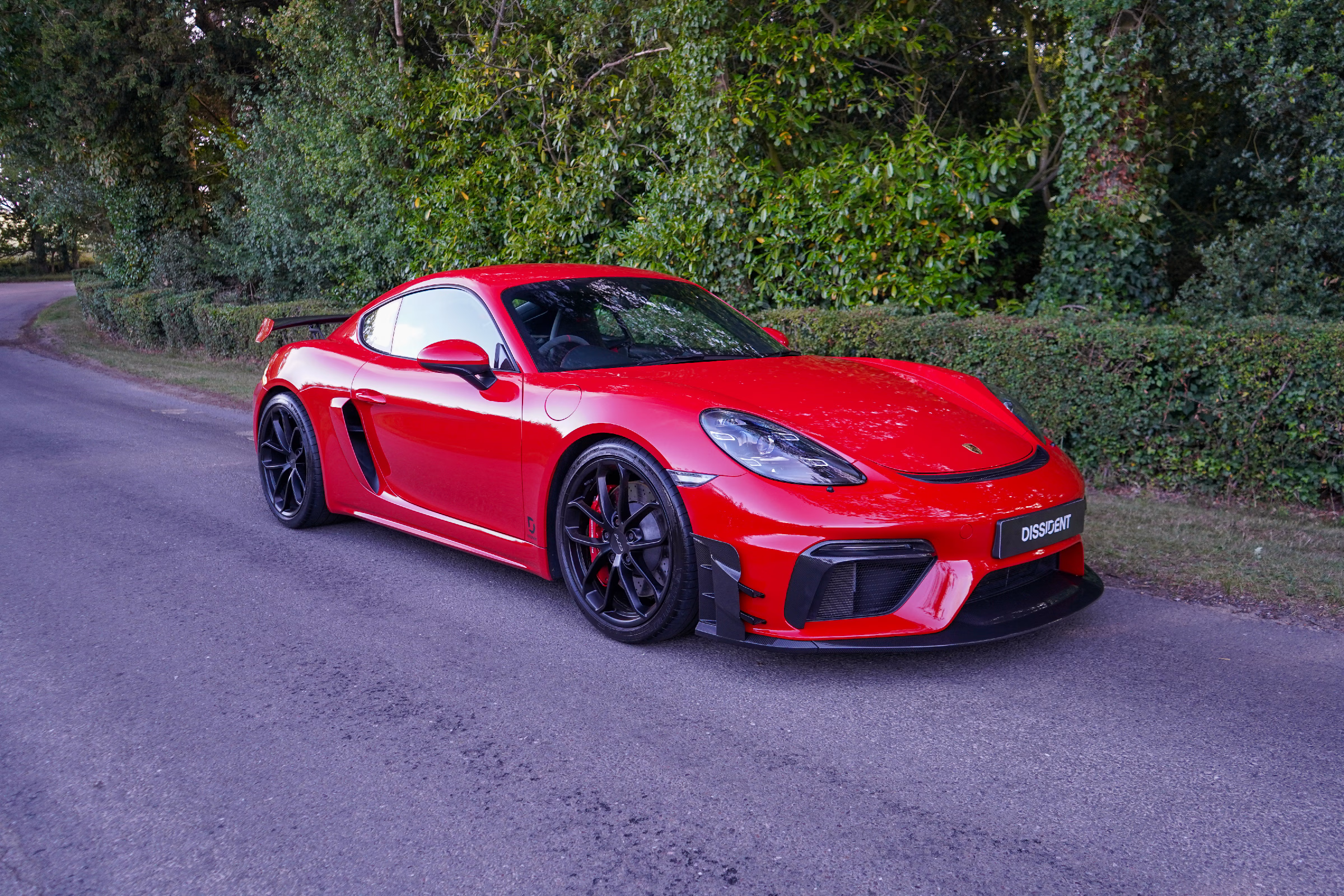
A buyer's guide to 718 Cayman GT4 and GT4 RS front end carbon: splitter, air curtains, diveplanes and the three packs compared.
Read articleA rear diffuser is an upswept section of the rear underbody that gives fast moving air under the car space to slow down and expand. That expansion lowers the pressure under the car and fills the wake behind it, which cuts drag and helps the whole underbody produce downforce. The outside air pressure does the pushing, not the diffuser itself.
A working diffuser needs three things: a smooth underbody feeding it, an expansion chamber at the right angle, and vertical fins to keep the flow in order. Most aftermarket parts have only the fins. Without a flat floor ahead of it a diffuser produces limited downforce, though it does tidy the turbulent air coming off the rear bumper.
Strakes divide the diffuser into channels, stop pressure equalising across its width, and shed vortices that act as virtual walls. They protect diffuser performance rather than create it. Fin count is a poor way to judge a diffuser, because more fins on a part with no sealed floor behind it is decoration rather than downforce.
Rear bumper type decides it, and on a 991 the exhaust does too. The 992.1 rear diffuser fits base rear bumpers, while Sport Design and GTS cars take a different part. The 991.2 diffuser fits Carrera models with the sports exhaust option and central exhaust pipes, so check the back of the car before ordering.
Check that the listing names pre-preg and autoclave, that the part is moulded for your specific bumper rather than trimmed to fit, and that it mounts on original points without drilling. Then look at fin depth for the cosmetic side, and think about ground clearance, because a diffuser hangs at the lowest point of the rear.